



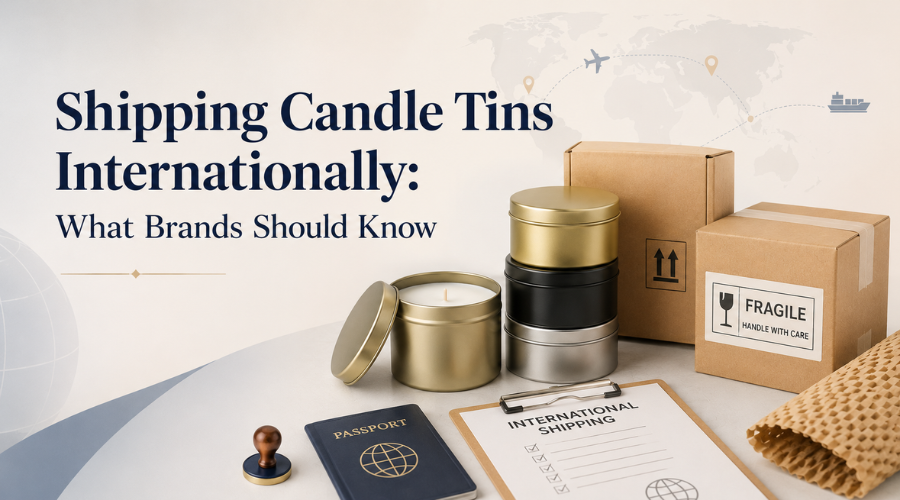
Shipping candle tins across frontiers is more than just making a container booking. Your timeline and costs depend on weight, fragility, customs rules, and material regulations. This guide will help brands understand the things to know before sending private label candle tins internationally.
Candle tins come with specific shipping challenges compared with other packaging types. Metal is heavy and therefore expensive to transport. Filled tins contain wax to respond to temperature fluctuations during long-distance shipping. Empty tins are lighter but must be handled carefully to prevent dents and scratches to the container, which could affect the container's brand image.
Brands importing candle packaging solutions from abroad should have a clear strategy for delivery, customs documentation requirements, and how to ensure the product reaches the customer in perfect condition.
Sea freight for bulk orders
Sea freight is appropriate for large bulk orders of private label candle tins, particularly for brands that order containers or half containers. Standard 20-foot containers provide plenty of space, so for large orders, per-unit shipping rates are lower than air freight rates.
Sea freight transit time is between 25-45 days depending on origin and destination ports. Brands should build this timeline into production plans, especially for the holiday sales season and candle releases.
Air Freight for Smaller or Urgent Orders
Air freight is typically 5 to 10 days faster than sea freight and costs considerably more per kg. Occasionally, companies switch to air freight to rush a new range of goods or replenish stock during periods of higher sales.
Empty tins pack more efficiently for air shipping than full ones because of the wax weight. Several brands produce empty private-label candle tins for export, then complete the candles closer to the point of sale.
Calculating Shipping Cost by Weight
Metal tins are heavier than plastic and cardboard tins. An average standard 8oz candle tin is 40g to 70g in empty weight, depending on the gauge and the lid design. When filled with wax, the weight per unit can range from 250g to 300g.
For cost, freight forwarders use either actual or volumetric weight, whichever is greater. Brands should ask their forwarder how their shipment is calculated, as actual weight pricing may sometimes prevail over volumetric pricing.
Packing Density
The advantage of packing is that it saves wasted space in containers. See how your candle packaging solutions supplier nests and stacks tins for shipping. Properly stacking the cartons with minimal space can help prevent damage during transport and reduce transportation expenses.
Dent and Scratch Prevention
Dents and scratches on metal tins are more noticeable than on other packaging materials. Ask about handling and interior packing materials, such as foam dividers, corrugated protectors, or paper wrapping. This will help protect the surface finish during transportation.
Humidity and Rust Risk
Tropical regions and non-climate-controlled warehouses can increase humidity on long sea freight routes and expose the tins to moisture. Ensure your supplier uses a rustproof coating on tinplate, and ask whether they package export boxes with desiccant to reduce moisture.
Harmonized System Codes
HS code classification will impact duty rates and customs clearance time. Empty metal tins are usually classified under an HS code other than that for filled candles, because filled candles involve an assembled product made up of wax, wick, and metal. Always verify the code with your customs broker prior to shipping.
Required Shipping Documents
When shipping to an outside country, you should have a commercial invoice, packing list, bill of lading, or an air waybill. Include a note on the flammability or wax composition testing that filled candle shipments might require depending on their destination country because of import requirements.
United States
The U.S. has standards for the flammability and labeling of filled candles, and in some instances, burn safety testing. Empty tins generally have fewer limitations but still need to be correctly classified with the HS code, and the country of origin will need to be marked.
European Union
EU member states often request materials used for packaging and candle wax to be submitted for REACH compliance. Brands need to verify that their tin coating and candle wax formulation comply with REACH regulations before shipping to companies in EU countries.
Other Key Markets
Fire safety regulations require some jurisdictions, such as parts of the Middle East and Southeast Asia, to issue additional import permits for filled candle products. Before making any arrangements to ship, be sure to verify particular requirements with a licensed customs broker in your destination country.
Why Experience Matters
A metal packaging freight forwarder will know the common documentation and typical customs questions applicable to candle products. This experience eliminates time lost spent dealing with a general forwarder that doesn't know the rules of candle imports.
Questions to Ask Your Forwarder
Ask whether they've ever handled candle or metal packaging shipments. Inquire into how they plan to manage customs holds or customs documents. Request an explanation of all import charges, such as destination port fees, that can sometimes come as a surprise to the first-time importer.
Brands that order private-label candle tins often customize them before they leave the manufacturing site. Check with your supplier to confirm whether labels are added before or after the tins clear customs in the destination country, as some countries require a local-language label before the tins can be offered for sale.
Unlabelled tins, with compliant labels added within the country, sometimes facilitate customs clearance, particularly for brands that sell across several countries with different labeling language requirements.
Duties and Tariffs
Import duties depend on the country and HS code classification. Confirm duty rate with your customs broker before deciding on your order quantities, as this will have a big impact on landed cost per unit.
Insurance for High-Value Shipments
For larger quantities of private label candle tins, use cargo insurance for custom designs with high tooling costs. Typically, insurance costs a few percent of the shipment value and protects against total loss due to shipping incidents, theft, or damage.
Candles also make seasonal brand launches, with candle collections around launch time scheduled for the holidays and around the gift time. Orders must be placed at least 90 days in advance of the anticipated launch date, based on sea freight being 25 to 45 days, plus potential customs clearance time. Shorter planning timelines are possible for urgent restocks through air freight; however, brands should not routinely plan for air freight because it costs more at scale.
Domestic Storage Considerations
If the candle tins pass customs, then storage remains an issue. Don't make filled tins too heavy when stored in warehouse racking, as long-term pressure may cause lids to become warped or cause wax to move. Empty tins can be stored in a more flexible way, but they can still be stored in a climate-controlled area to avoid surface corrosion before being refilled.
Dealing with Damaged or Rejected Units.
Despite careful planning, some commercially received units will be damaged or fail quality checks post-customs. Have a clear process with your supplier: damage claims, including photo documentation and reporting deadlines. Most suppliers will cover a credit amount for documented transit damage in a specified claims period after delivery or in part after it reflects.
Regularly review freight performance.
Monitor shipment delays, damages, and transit time on multiple shipments. This information helps identify consistent issues with a particular route, forwarder, or packaging design. For brands that ship regularly, reviewing this performance data at least twice a year will be beneficial.
Renegotiating Freight Rates as Volume Grows
As orders increase, freight prices typically rise, too. After you set up a regular shipping schedule, review your freight forwarding contract to confirm you are still getting competitive pricing. Forwarders may offer more favorable rates for brands with regular, consistent shipment volumes.
Evaluating Export Experience
Ask your candle packaging solutions supplier how many international shipments they carry each month and where. An experienced supplier that has shipped to your export country is more likely to know what forms are needed than one exporting for the first time.
Sample Shipments Before Bulk Orders.
If a full container order is required, consider placing a smaller trial order, particularly if ordering from a new supplier or when entering a new market. This is a real test run that shows true transit times, friction points for customs, and packaging durability in actual shipping conditions.
When planning international shipping, consider the weight of the candle boxes, packaging protection, and paperwork. Find a supplier with sea freight export experience, agree on reasonable and reliable transit and customs timelines, and prepare and negotiate HS codes and certifications in advance. This helps maintain product quality and your launch schedule.
Where can I purchase a bulk supply of private label candle tins online?
You can find a dependable supplier from trusted trading forums or by reaching out to a trusted packager exporter.
What is the best way to select the top supplier for candle packaging solutions?
Verify export experience, HS code knowledge, and packaging protection techniques before placing a bulk international order.
How do I buy candle tins for the international market?
Ensure your supplier knows the customs and labeling requirements of your target market, and ask for a sample shipment.
How long does it take to ship candle tins by sea transport?
For sea freight, the shipment takes approximately 25-45 days, depending on the port of origin and port of destination, as well as customs clearance time.
Are the import rules different for filled candles as opposed to empty tins?
Yes. Unlike tins, which do not need to include flammability or wax composition information, filled candles may require it.
Metal tins are everywhere. Candles, coffee, cookies, gifts, and cosmetics. They all use them. When people have products to sell, they'll likely need packaging. And that packaging needs to be reliable. This guide takes you step by step in choosing the right metal storage tin supplier for your business. We'll cover quality checks, pricing, lead times, and long-term partnerships. Why does the right tin supplier matter? Your product packaging is often your customer's first impression. It makes its impression on them. If the tin can is poor, it can rust and can look cheap. A good tin does the opposite. It keeps your product safe. It looks professional. It creates trust and guarantees buyer satisfaction before they even crack open the lid. This is why it is not an easy choice to find the right metal tin box wholesale supplier. It influences your brand and impacts your expenses. It influences customers' satisfaction. Know Your Business Needs Before You Begin. Know what you need before searching for suppliers. Transparency is a time saver. Start with size. What sizes fit your product? Next, consider shape. Each and every tin, whether round, square, or rectangular, conveys different messages. Then consider whether you'll need custom printing or tins made from plain stock. Lastly, estimate your quantity and your target price per unit. Write these answers down. They will lead all discussions with suppliers. Otherwise, you end up spending weeks trying to compare quotes that aren't comparable. It's also possible to choose the wrong partner. Check Their Manufacturing Capabilities Not every supplier will be the same. Some only work on a small scale. Some specialize in volume orders and have trouble with quantities less than ten thousand units. Ask targeted questions at the right time. Can they make your exact tin size? Do they provide standard molds, or custom shapes? What metal thickness do they use? Can they meet your order volume during peak seasons? A true Metal Storage Tin supplier should have versatile production lines. Look at Material Quality Not all metals are created equal. Cheap tinplate rusts very quickly. It dents easily. In some cases, it may even change the fragrance or flavor inside! Good suppliers use food-safe materials when needed. This is an important factor to consider if you are packaging edibles, tea, coffee, or cosmetics. Request material certificates. Reputable suppliers will readily provide these documents. Do not buy from a supplier who cannot provide them. Look at Printing and Finishing Options Branding matters. You're not just holding on to a tin. It can sit on a shelf or countertop and market your brand for months. Check what printing options they offer. With offset printing, you receive a full-color artwork. Embossing and debossing add texture. A matte or gloss finish can make a big difference. Spot UV coating highlights a logo. The more choices you have, the more creative freedom you have. Request a few samples and study these carefully. Inspect for sharp corners, accurate color registration, and an even finish in the lot. A good metal tin box wholesale supplier will proudly show off their printing work. Their portfolio should be ready to answer your questions. Request Samples Before Committing Don't skip this step. Get samples before you decide. Photos don't always tell the whole story. Lighting and retouching can conceal a lot. Samples don't lie. Once you receive them, look closely at how they look. Does the lid fit correctly without pushing it? Is the seam even and smooth? Are there any sharp edges that could cut a customer? Can you see the print clearly in normal light? Does the tin feel sturdy when you press the sides? Compare Pricing Carefully While price is important, it is not the only consideration. Low-cost tins may be cost-effective at first. They can cost you much more later through returned products, complaints, damages, etc. When requesting a quote, inquire about the total cost. • What is the minimum order quantity? • Does it offer a discount on larger orders? • Are tooling or mold fees add-on costs? • How much will shipping cost? • How will payment be made? Evaluate quotes from at least three suppliers and compare them. Don't just look at the unit price. Consider factors like shipping costs, import taxes, and hidden charges. Check Minimum Order Quantities All metal storage tin suppliers request different MOQs. Some require thousands of units per order. Others are flexible for smaller businesses and start-ups. If you're starting out, look for suppliers with lower MOQs. This limits your risk and allows you to save money for other aspects of your business. Higher volume also means better rates as your sales grow. Avoid signing any agreements without clarifying MOQ first. These unexpected events can adversely affect cash flow. Evaluate Communication and Support Communication is the key to avoiding headaches. When you first interact with them, watch them for their reactions. Do they respond to questions within a day? Do they give direct or indirect answers? Do they actually seem to understand your requirements? Do they respond patiently to change requests? An effective supplier at the start will remain effective over time. When communication is lacking, it means it will be lacking later. This becomes a pain when you lose a shipment or when a print run is incorrect. Inquire about lead times In business, time is important. Late delivery hurts sales, especially during busy periods such as holidays. Ask your supplier about typical production and shipping times. Ask whether you can order quickly and at what price. What do you think will happen if they slow down? If you find a reliable metal tin box wholesale partner, youwill get reasonable timelines. They will not promise anything more than they can deliver. Schedule extra time in your plans, even if you have to. Also, with top-quality suppliers, things can go wrong. Check Their Track Record Experience matters. Avoid suppliers that have been around for a few months rather than years. Read client reviews and client comments. Request a portfolio or case studies for previous projects. Check how long they've been operating. Check ISO 9001 or other certifications as required for food safety. If a supplier has been operating for a long time, they are probably stable. It also suggests they have already faced and solved the common challenges newer factories encounter. Look for reviews from unbiased websites. Check industry directories and sourcing platforms too. Conclusion Selecting the right metal tin box wholesale partner isn't easy. The right supplier keeps your product secure, strengthens your brand, and saves you money over time. Take your time. Communicate effectively by asking the right questions. Request samples. Compare options carefully. Good relationships with a trusted metal storage tin supplier can prove to be among the greatest business decisions you make. Frequently Asked Questions What is the best place to purchase metal tin boxes wholesale? There are sourcing platforms in between, such as Alibaba and Global Sources. A direct factory supply almost always has a lower cost for a long-term supply. How do I find a reliable metal storage tin supplier? Begin with credentials, longevity of service, and real references from actual clients. Then order samples and make your own decision about the product. Any supplier that takes its time and is uncertain prior to your settlement will be less responsive afterward. How to buy Tin boxes wholesale at the lowest price? Order stock sizes rather than custom shapes. Use black print or single-color printing. Add more orders to reach price breaks. Use sea freight instead of air. Combine several SKUs into one shipment. All of these significantly reduce your unit cost. What is the cost of wholesale tin boxes per unit? Small plain tins can fall well under a dollar at volume. Larger custom-printed tins with special finishes cost several dollars each. Prices are affected by size, metal thickness, printing, and quantity. Don't hesitate to ask for a quote for your specific requirements.
READ FULLWorth of Custom Shoe Care Packaging Selection Before using shoe wax, the first thing buyers notice is the packaging. If it is impressive, they will go to try the wax or polish inside. This means that packaging is the most important factor that can make your target audience take action. This is where custom shoe care packaging does something more impactful, and brands know about it. Small, medium, and large shoe care product companies can not rely on dull or standard packaging anymore. They need something more captivating and flexible to cater to a wide range of audiences depending on shoe type and color. So, they need a custom manufacturer who can provide tin packaging for shoe care products for irresistible packaging. If you are among those brands, you need to do a little comparison when shortlisting the best names in the industry. This guide can help you with that in a simpler way than you can expect. Certification and Industrial Experience What you need to consider first of all is production certification. Without them, a manufacturer cannot qualify for the rest of the steps. If a manufacturer has certifications like REACH, ISO 9001:2015, and ISO 14001-2015, you can go ahead for the next process. These standards show that a manufacturer follows globally accepted quality standards in the production process. Then you need to look at the industrial experience. If a manufacturer has over five years of experience, it is better to have some trust in it. This much time is good enough for a manufacturer to have experience in any industry. However, you might see many with decades of experience with limited options and some with a few years of experience with lots of features. It depends on what you need. Tin Quality, Structural Durability, and Functionality Now you need to analyze the quality of tin packaging. The tin in production has to be smooth, high-quality, and shiny. The tin has to be of top-grade quality to meet the requirements of a shoe care product. Keep in mind that bulk metal tins for shoe brands must have high rust resistance. This includes structural durability against dents, punctures, and collapse during the shipping process. • Choosing high-grade tin provides high structural accuracy and durability. The wax or cream inside remains safe from suppression if the borders of the tin packaging are rigid enough to bear pressure. • If we talk about functionality, it is mostly about lid fitment. If the lid fits perfectly and works without any failure, it qualifies for the wax packaging. • If we look at the interior of tin packaging for shoe wax or cream, there is no need for special coating inside the tins. However, a lacquer lining can help prevent any sticking and chemical reaction between the tin and wax. Height and Diameter of Tin A shoe care product’s tin packaging has variable dimensions. They go from small to large sizes, where common sizes are 15 gm, 40 gm, 100 gm, and some custom ones. Ask the tin packaging manufacturer about their production capacity for different packaging sizes. Compare the customization options of your selected manufacturers, which will help you choose the best one. Selection of Lid Type There are mostly two types of lids in shoe polish tin packaging. One is a slip cover, and the other is a screw-top cover. The cost can vary because of this difference, and the screw-top cover is slightly costlier. However, it could offer more control. Besides, standard shoe wax tin packaging has slip lids. You can compare lid types and customization options to further finalize your supplier. Production Size and MOQ You need to make sure that whichever manufacturer you are selecting has a large enough production capacity. Before going for customization, make sure that the manufacturer can keep up with the demand. There must be large enough production capacity to back at least five hundred thousand units per month. Besides, the minimum order quantity must be flexible enough to match your affordability. Some manufacturers have almost every feature, but their MOQ is very large, and that creates an affordability problem. So, look at this factor when finalizing the order placement process. Range of Customization for Bulk Metal Tins for Shoe Brands When it comes to comparing customization, you need to look at primary features first. The shape, size, and thickness/rigidity of packaging will be as per your requirement. If a manufacturer can exactly offer you what you need, then move on to secondary customization. Printing Types and Finishing Secondary customization is about labeling, which is all about printing and finishing. Choose the color, logo, theme, and surface finish to compare which manufacturer has the most varieties. CMYK format, offset printing or lithographic printing, embossing, debossing, matte, and glossy finish are some options usually offered by custom manufacturers. Choose whichever suits your brand. Sample and Production Timeline To compare which metal tin manufacturer really fulfills your requirements, ask for samples. When you ask for a sample, ask for the estimated production time once a sample is approved. There must not be any delays in production because if someone gives a longer duration, there will possibly be problems for you later. Choose a manufacturer who has not only services but can also fulfill them on time. Sample Inspection Once you receive the sample, inspect its printing quality, including color consistency, depth, and sharpness. The letters, patterns, and edges must not intermix or blur in any way. Price Comparison Once you approve the sample and get production details, it is time to place a full-scale order. The initial price is usually available on B2B platforms, but then comes the negotiation factor. You need to ask your final supplier for a mega discount when placing a custom order. The price has to be affordable as per your budget. Perform an estimated cost analysis through forecasting. After that, you can go ahead with the rest of the logistics process and the costs involved in it to measure the full ownership cost. Conclusion The first thing you need to do is collect all the best possible names of suppliers from B2B platforms. Then go through their services and initial prices mentioned on the platform. See their certifications and experience to shortlist them. Then do further analysis of tin quality, structural durability, functionality, dimensions, and lid types. After that, ask for production size, MOQs, and customization. Customization will further expand into options like size, printing, and surface finishing. Once you go through them, go for sample inspection to place a full order and select the prices. Frequently Asked Questions What Features Should I Compare When Selecting a Metal Tin Shoe Packaging Manufacturer? Compare tin quality, structural strength, functionality, production size, and range of customization. Then further compare customization about dimensions, printing types, and surface finishing. Then inspect the sample to compare which custom manufacturer offers the most services. Which Factors Affect the Cost of Production in Metal Tin Shoe Packaging? The simpler the tin packaging for shoe wax is, the lower the cost will be. The more customization there is, the higher the cost will be. However, choosing a wholesale custom manufacturer can provide affordable prices where the per-unit cost is very low. Heyi Changsheng E-Commerce Co., Ltd. can be one of those who offer such affordable customization. Who Could Provide a Wide Range of Customization in Tin Shoe Care Product Packaging? There are many manufacturers who can offer wide customization in tin shoe care packaging. One of them is Heyi Changsheng E-commerce Co., Ltd. This manufacturer offers wide customization and a feasible price range for all global buyers. Shoe wax brands can outsource their packaging for cost-effective and impactful results.
READ FULLTin gift boxes are appealing to buyers across many categories. Brands use them for food, cosmetics, and holiday retail. The metal tin gift box distributor you choose will affect product quality, margins, and delivery times. This guide will help importers and retailers through key factors to consider before ordering in bulk. Why Tin Gift Boxes Remain Popular Tin gift boxes are much more durable than cardboard and plastic gift boxes. They help prevent crushing during shipment. They also have a luxury feel that helps to justify premium retail pricing of gift products. Wholesale buyers of gift tin boxes usually serve a variety of end markets, including candy companies, tea and coffee companies, cosmetic companies, and holiday retail stores. These tin boxes are also versatile, making them a great option for distributors who want to diversify their product offerings. Learning About Tin Gift Box Making Materials Standard and Thickness Tin gift boxes are manufactured from 0.2 mm to 0.3 mm thickness of tinplate steel. A thicker gauge is more difficult to dent when loading and unloading, but it is heavier and more costly per unit gauge. Explain what gauge each box will be; sometimes suppliers may use different thicknesses depending on the box size. Coat and Finish Options Coating the tinplate with a material that will not corrode is necessary. The most popular coatings are clear lacquer, matte finish, and glossy finish. Some manufacturers can provide special finishes, like embossed or soft touch, to help with premium positioning at a premium price. Common Tin Gift Box Shapes and Styles Hinged Lid Boxes Hinged lid boxes let the lid open like a book, and a small metal hinge keeps it together. Ideal for use in gift sets, jewelry presentation, and high-end candies, where presentation is as important as protection. Slip Lid Boxes The slip lid boxes have a removable plastic lid. This makes construction simpler and is typically less costly than the hinged design. Slip lid boxes are still used for tea, coffee, and many other product sales and are available at a variety of prices. Nested and Multi-Piece Sets Some buyers request boxed sets containing several different tin sizes stacked inside each other for efficient shipment and storage. The sets make sense for retailers offering tiered sets or seasonal bundles of containers that need several sizes. Standard Sizes for Wholesale Tin Gift Boxes Wholesale tin gift boxes come in a variety of shapes and sizes, from small favor boxes of 5 cm-8 cm to gift boxes of 20 cm-25 cm. Confectionery and tea brands will prefer medium sizes, 10 cm-15 cm. They fit the usual product quantities of retail stores and reduce packaging waste. Check the standard sizes your metal tin gift box supplier offers before ordering custom tooling, as standard sizes are typically more affordable and delivered faster than custom sizes. Custom Branding and Printing Options Printing Methods Tin gift boxes can be printed using a variety of techniques such as offset lithography, silk screen printing, and embossing. Offset printing suits intricate, multicolored designs. Silk screen printing suits simpler designs in fewer colors and with high color density. The embossing effect provides a premium, tactile feature that doesn't require color to be appreciated. Minimum Order Quantities for Custom Printing Custom printed tin gift boxes usually have larger minimum stock levels than the stock designs. The minimum order quantity (MOQ) for custom printing typically begins at 2,000 pieces, which can vary based on the specific design and manufacturer. Ask your supplier whether they offer a lower MOQ for simpler one- or two-color designs. Comparing Suppliers: What to Ask Production Capacity and Lead Times Ask about the monthly production capacity and lead times of any gift tin box wholesale provider. Stock designs typically take 15-25 days to arrive after the order is confirmed. For more complex designs and busy factories, lead times for custom tooling or printing can be extended to 35-50 days. Quality Control Practices Question whether the supplier inspects boxes throughout the manufacturing process or just before delivery. If the supplier finds print misalignment, seams, or coating issues early, the risk of shipping an entire batch of faulty products decreases. Ask for a routine inspection process checklist before placing an order. Sample Approval Process Do not order without first receiving a physical sample. Samples can be used to check lid fit, hinge strength, print accuracy, and overall finish quality. When deciding which supplier to depend on, evaluate the quality of 2 or 3 different samples; specifications will not always tell the whole truth. Pricing Structure Beyond Unit Cost Tooling and Setup Fees If the shape or embossing is custom-designed, a single tooling fee may apply in addition to the unit price. Follow up to see whether this is a refundable fee or if it is charged for future purchases. Some manufacturers offer it as a return-customer incentive. Freight and Incoterms Specify the Incoterms to be used in your quote (FOB, CIF or EXW). This influences risk management of freight, insurance, and clearance of goods. Discuss these terms before import so they don't come as a shock when the goods arrive at the port for a first-time importer. Tin Gift Boxes Import Considerations. Harmonized System Codes The classification is used to calculate duty rates and speed of customs clearance. In general, empty tin boxes are classified as general metal packaging, but classifications can vary by destination country. Review the code with a customs broker before shipment. Country-Specific Labeling Requirements In certain destination markets, country-of-origin labeling or documentation is required. Other documents related to food-contact safety requirements may apply if your tin gift boxes are intended to hold food products. Always confirm with your supplier and customs house before ordering. Packaging for Safe International Shipping Although tin boxes are sturdier and less prone to crushing than cardboard boxes, they still require protection against damage during transit to prevent dents and scratches. Ask your supplier about packing methods and whether they use interior dividers, corrugated outer cartons, and shrink wrap for container shipments. Ask the supplier about their experience with postal damage in international shipments, if any. A supplier who monitors this regularly is more likely to prioritize quality assurance during the shipping process. Seasonal Demand Planning Seasonal products, such as holiday tins and confectionery tins needed at specific times of year, are often purchased wholesale. Typical lead time and shipping time is 3 to 4 weeks, so buyers should order at least 90 days before the desired selling season. This buffer will prevent shortages during high-demand periods and reduce the risk of production and customs delays. Sustainability Considerations Recyclability Advantages Tin is a highly recyclable material when compared with a number of options for plastic packaging. This makes it appealing to customers seeking a sustainable answer to retail markets. Marketing this recyclability will benefit brands, particularly those that sell through stores with sustainability commitments. Reduced Material Options Some manufacturers have begun to provide thinner-gauge options without sacrificing durability, and they have also improved structural efficiency to minimize material consumption. If sustainability is a key issue for your customers, ask your metal tin gift box distributor whether they offer any reduced-material product lines. Developing a Long-Term Supplier Relationship If you know and trust your supplier, quality and consistent communication are sometimes more important than trying to get the best price elsewhere. Place repeat orders with a supplier who understands your requirements and can work on your order during busy seasons. Always re-evaluate the relationship with your supplier, even once you've established a successful relationship. Material value and capacity are variable; review with the supplier every year to ensure competitive terms for your company's growth. Be sure not to make these mistakes. Sometimes buyers focus only on the unit price and neglect material gauge or coating quality, which can cause damaged shipments or have inconsistent finish quality. It often doesn't work when the sample batch has quality problems, but the bulk batch shipments aren't made until after the launch date. Great lead times can also catch you out if they're underestimated, particularly for custom-printed designs, or if buyers don't add a scheduling buffer to their products. Conclusion The decision of which wholesale tin gift box supplier to choose isn't based only on unit price. Your order delivery and quality depend on material gauge, coating quality, delivery time, and sample verification. Make sure that you have done your research before ordering in bulk from a supplier. Frequently Asked Questions Where to purchase tin gift boxes in bulk online? You can do this through reliable sources such as verified trade platforms or by contacting established metal packaging exporters directly. How to select the right supplier of tin gift boxes? Before placing a bulk purchase order, compare material gauge, coating quality, lead times, and sample quality. Where can I get tin gift boxes for my retail shop? Work with a metal tin gift box supplier that offers low MOQ, competitive pricing, and consistent production schedules. What is the usual minimum quantity for custom printed tin gift boxes? Usually, the MOQ for custom printed designs is 2000 to 5000 pieces or fewer for stock designs. What is the delivery time for wholesale tin gift boxes? Stock designs are normally delivered in 15-25 days, and custom printed or tooled designs are usually delivered in 35-50 days.
READ FULL